
Finite Element Link
1. 6DOF
2. CASE Software
3. COSMOS/Exchange
4. Engineering Software Center
5. The FEA Portal
6. The FEM Site
7. FEMOOP
For complete link click here
Thursday, October 21, 2010

Springback Behavior Prediction of Benchmark Problem II Numisheet 2008 Model Under Smooth Drawbead
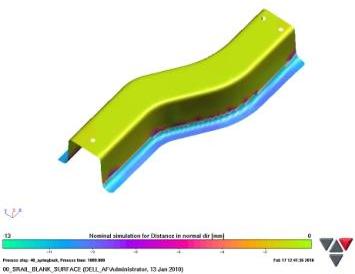
An accurate modelling of the sheet metal deformations including the springback prediction is one of the key factors in the efficient utilisation of Finite Element Method (FEM) process simulation in industrial application. The accurate simulation of the drawing products will not be useful since springback will occur after the tools are removed off the drawing die set. The springback prediction should be further performed to see the final formed shape after the elastic recovery. The elastic behaviour of the metal will be contributing to other geometrical forming defects, such as thinning and wrinkling.
This paper presents an evaluation of a standard benchmark model defined as Benchmark II of Numisheet 2008. This is an S channel model with various drawbeads. For benchmark evaluation purpose, only smooth drawbead is chosen and two finite element application packages based on implicit codes i.e DYNAFORM and AUTOFORM are utilised for simulating the forming process as well as the calculation of the springback distortion.
Results are presented with comparison of the two packages. The simulation strategy involved are discussed to provide a general approach that may influence the results. The results are also revealing the influence of the smooth drawbeads when this type of bead is introduced to the model.
The simulation results show that the application of implicit finite element code in predicting springback distortion is sufficiently effective. The two simulation results from different commercial packages are in a good agreement. One thing that should be taken into consideration for further research is accommodating springback to obtain a better geometrical accuracy.
Keywords: Smooth Drawbead, DYNAFORM, AUTOFORM, Springback
Thursday, December 3, 2009
Hot Forming with AutoForm

AutoForm Engineering GmbH, the leading supplier of software solutions for the sheet metal forming industry, has successfully developed an innovative solution for hot forming simulation. AutoFormplus R1 supports direct and indirect hot forming as well as other processes which involve temperature or strain-rate dependent material.
Hot forming processes have recently become important for the automotive industry to meet specific requirements regarding a higher level of crash safety and a reduction of overall weight. Many automotive manufacturers use these processes to produce body structure components such as A and B-pillars, tunnels, front and rear bumper beams, door sills, door beams, side-rail parts, roof rails and roof frames. These components have the highest requirements regarding strength. The use of high strength steels in conventional stamping processes is difficult due to their reduced formability and strong tendency to springback. Hot forming technology can be used in order to overcome these limitations. Components are stamped in the soft stage at elevated temperatures and quenched after forming to achieve a martensitic structure resulting in a very high strength of 1500 MPa.
Hot forming is a temperature and time dependent process and therefore its simulation is obviously more complex compared to conventional stamping processes. AutoFormplus R1 has been enhanced to include thermo-mechanical processes, making it possible to simulate hot forming.
Dr. Waldemar Kubli, CEO of AutoForm Engineering, stated: “We are glad that our solution for hot forming brings a new set of benefits to our users. By applying our innovative technology, they can effectively simulate the hot forming process. Thus, components with high strength, high geometrical complexity and minimized springback effects can be produced in shorter time at lower cost. Despite the complexity of hot forming processes, AutoForm has succeeded in developing a hot forming solution which offers AutoForm users the level of user-friendliness they are accustomed to.”
Skywatcher
An astronomer observes the Orionids at an observatory near the village of Avren east of the Bulgarian capital Sofia. The Orionid meteor shower occurs each year as a result of Earth passing through cosmic dust released by Halley's Comet. The radiant of the Orionids is located near the constellation Orion
Subscribe to:
Posts (Atom)


